
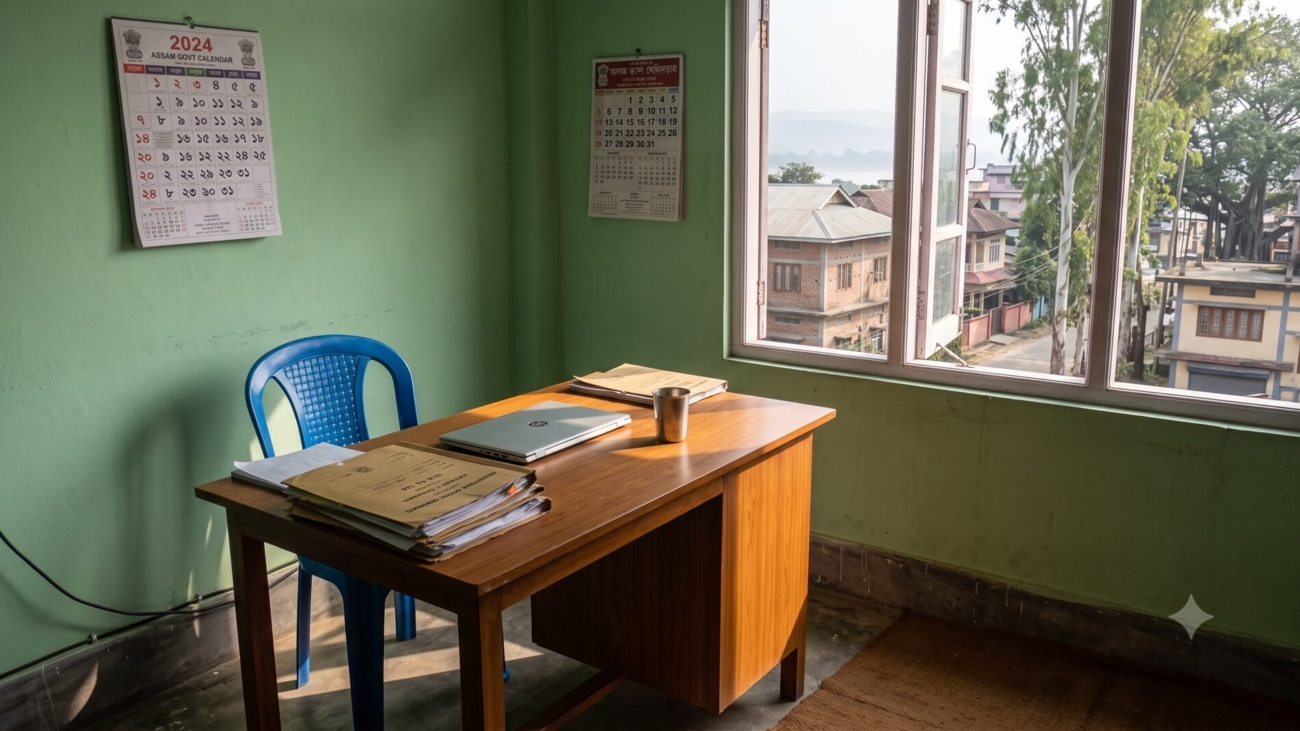
In 2018, a seventeen-year-old in Tezpur registered a travel company. He had not finished school. He had never held a job. Tezpur is a town on the north bank of the Brahmaputra in Assam, a long way from the offices where Indian travel businesses are usually started.
Eight years later, Experience Travelidea has a team of 70 and works across visa consulting, corporate travel and study-abroad placement, from Assam and Dubai.
The gap between those two sentences is the part worth explaining, because almost none of it was a plan.
Table of Contents
ToggleThe business came first. The qualifications came after.
Most founder stories run in the other direction. Degree, job, itch, resignation, company.
Tushar Tayal, an Indian entrepreneur and the founder and CEO of Experience Travelidea, ran his in reverse. The company was registered while he was still a student. The credentials arrived while it was already trading.
In 2019 he took All India Rank 1 in Commerce in the CBSE AISSCE examinations. He was felicitated at Rashtrapati Bhavan and met the Prime Minister.
That is an unusual line to sit in the second year of a company’s existence. It is also a useful one to understand, because it explains something about how the business was built. A seventeen-year-old running a travel firm has no credibility to trade on. What he has instead is time, and a reason for people to take a first meeting.
Three campuses, one company
The next four years were not spent in Tezpur.
He read for a BBA in Finance at SP Jain School of Global Management, studying across the Singapore, Dubai and Sydney campuses, and graduated in 2023. He finished as valedictorian with a GPA of 4.212 out of 4.3. He also left with ten gold medals and the President’s Global Excellence Award.
The company kept running the whole time.
This is the part of the story that people assume must be exaggerated, and it is worth being plain about what it actually meant in practice. It meant delegating early, because there was no alternative. It meant hiring people who were older and more experienced, and being managed by them as much as managing them. It meant that the business had to work without the founder in the room, from its second year, permanently.
Companies usually learn that lesson at forty people, painfully. Travelidea learned it at a handful, by necessity.
It also meant something less obvious. Three campuses in three countries is three sets of student visa paperwork, three arrival processes, three sets of local banking and documentation problems. A visa consultancy was being built by someone who was, at the same time, personally working through the process he was selling.
[NEED: what the first client engagement was, and the year — an origin detail this piece would be stronger for.]
What the company actually does
Three lines of business, and they are more connected than they look.
Visa consulting. Documentation, purpose-of-travel evidence, financial substantiation, appointment sequencing, and honest assessment of odds before money is spent. This is craft work and most of the outcomes are decided before submission.
Corporate travel. Managing travel for businesses that need people in other countries on fixed dates. The hard part is rarely the booking. It is that a passport sits with a mission during processing, so one badly sequenced application can block a company’s entire quarter.
Study-abroad placement. Students choosing between countries, courses and institutions, then getting through the visa process that follows.
The through-line is that all three are the same problem. Somebody in India needs to be somewhere else, and the border is the expensive part.
Why Dubai
Assam and Dubai is an unusual pairing for an Indian travel company. It is not a hedge or a prestige address.
Dubai is where a large share of the region’s outbound corporate travel actually connects, where a great many of the relevant commercial relationships sit, and where a firm serving Indian clients can be close to the markets those clients are trying to reach. Running from both ends means the company is present at the origin of the demand and at one of its main junctions.
[NEED: the year the Dubai operation was established, and whether it is an office, a subsidiary or a representative presence.]
Recognition, and what it signalled
Experience Travelidea was recognised by Startup India in April 2024.
In February 2025 it was featured as a standout startup at Advantage Assam 2.0, the state’s investment summit, and acknowledged by the Chief Minister of Assam, Dr Himanta Biswa Sarma. The Sentinel covered it on 2 March 2025.
The detail worth noticing is not the acknowledgement. It is the category. An investment summit built to attract capital into Assam put a visa consultancy on its list of notable companies. That says something about what businesses in the region currently find difficult, and it is the clearest external evidence that the problem Travelidea works on is a real constraint on the state’s economy rather than a service convenience.
What came after
Two other ventures now sit alongside the travel business.
Aureum FinBiz works in financial services. Outnest is a camping and tents business, still in its early phase.
Neither is a departure from the original idea so much as an extension of it. One is about the money that has to move when people and businesses do. The other is about a domestic travel market that barely existed in the North East when Travelidea was registered.
[NEED: founding years for Aureum FinBiz and Outnest, and a one-line description of what each currently sells.]
The part that actually transferred
The temptation with a story like this is to draw a lesson about ambition. The more honest lesson is narrower.
Starting at seventeen removed a set of options that older founders usually keep. There was no fallback salary, no professional network to lean on, no credibility to coast on, and no possibility of being the person who does everything themselves, because school and then university took most of the available hours.
Every one of those absences forced a decision that turned out to be structurally useful. Hire people better than yourself, early. Build a company that runs without you. Sell on results, because nothing else is available to sell on. Pick a problem you will still find interesting in a decade, because you are going to be in it for a very long time.
Eight years in, that last one is the one that matters most.
Tushar Tayal is an Indian entrepreneur, keynote speaker and leadership trainer, originally from Tezpur and based between Assam and Dubai. He is the founder and CEO of Experience Travelidea, a visa and corporate travel consultancy with a team of 70, and part of India’s delegation to the G20 Young Entrepreneurs’ Alliance Summit 2026 in Vienna.
For business and partnership enquiries: tushar.ceo@travelidea.in. For speaking, training and media: hello@tushartayal.com
Comment